Ceylon cinnamon vs cassia.
Most cinnamon sold worldwide is not true cinnamon. Here is how genuine Ceylon cinnamon differs from cassia — and why it matters for food producers, retailers and consumers.
Last updated: 2026-07-05
What is Ceylon cinnamon?
Ceylon cinnamon (Cinnamomum verum, “true cinnamon”) is the inner bark of a tree native to Sri Lanka, hand-rolled into quills made of many paper-thin layers. It has a light tan-gold colour, a delicate, naturally sweet flavour and a refined aroma — and it is naturally very low in coumarin (typically around 0.02 g/kg), which makes it the safer choice for regular, everyday use.
What is cassia cinnamon?
Cassia (Cinnamomum cassia and related species) is the common cinnamon of commercial markets. It forms a single thick, hard scroll of bark with a darker colour and a stronger, spicier taste. Cassia contains substantially more coumarin — up to 1 g/kg — which is why EU regulators limit coumarin intake and why frequent, heavy use of cassia is less ideal.
| Aspect | Ceylon cinnamon (true cinnamon) | Cassia (common cinnamon) |
|---|---|---|
| Coumarin content | Trace amounts — typically ≈ 0.02 g/kg; safe for regular daily use | Up to 1 g/kg; heavy long-term use may strain the liver |
| Flavour | Smooth, naturally sweet, delicate — blends well in tea, desserts and fine cuisine | Stronger, spicier, more pungent — used in bold cooking |
| Bark & texture | Many paper-thin layers rolled into a quill; snaps easily | Single thick, hard scroll of bark |
| Colour | Light tan-gold | Darker reddish-brown |
| Market position | Premium spice valued for purity, delicate aroma and quality | Cheaper, more common commercial alternative |
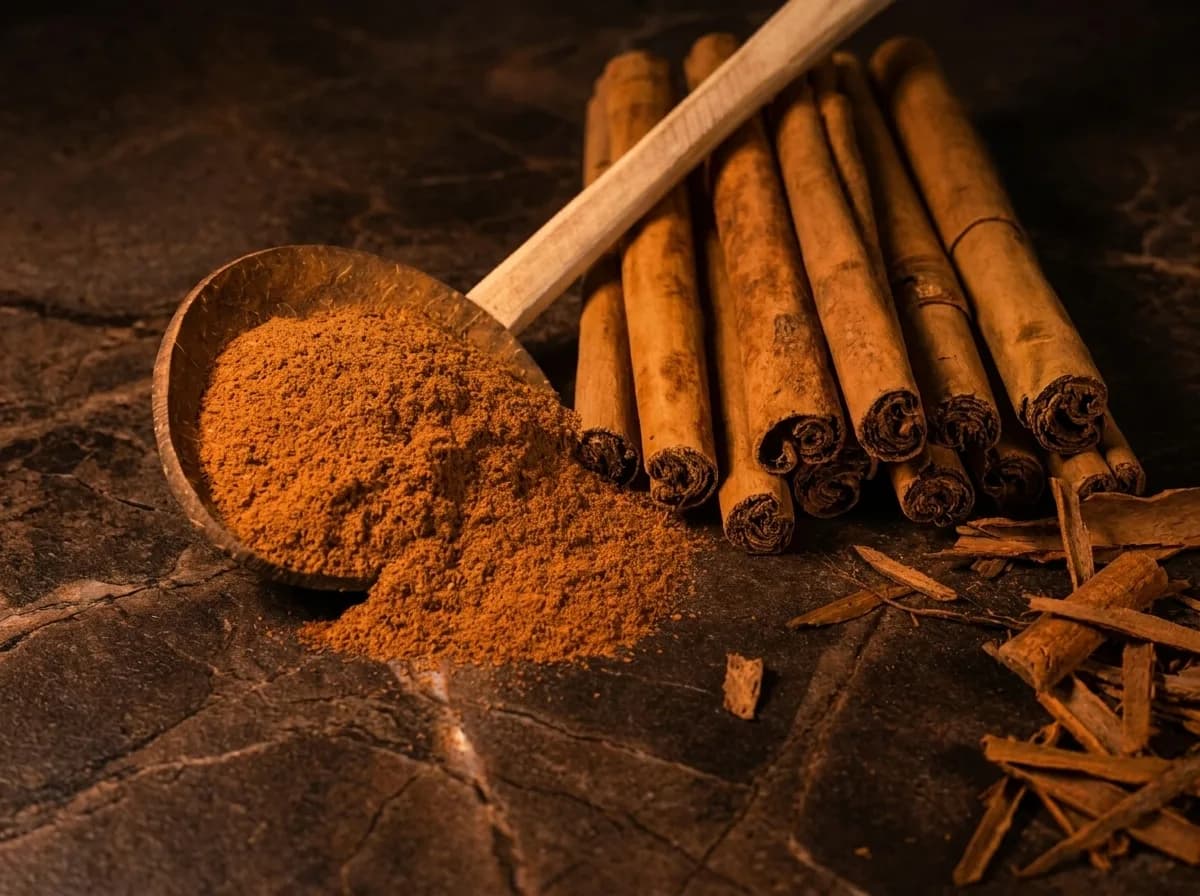
How to tell them apart
- Look at the cross-section: Ceylon quills show many thin layers, like a rolled cigar; cassia is one thick curl.
- Snap a quill: Ceylon breaks easily and cleanly; cassia is hard and woody.
- Check the colour: Ceylon is lighter tan-gold; cassia darker reddish-brown.
- Smell it: Ceylon is delicate and sweet; cassia sharp and intense.
How to verify true Ceylon cinnamon
Before committing to volume, verify the bark itself. Cut a quill crosswise: true Ceylon cinnamon shows many paper-thin layers of inner bark rolled together like a cigar, while cassia is a single thick curl with a hollow centre. The colour should be a light tan-gold, not the dark reddish-brown of cassia. Texture is equally telling — Ceylon bark is brittle and paper-thin, snapping cleanly under light pressure, whereas cassia is hard, woody and difficult to break. The aroma is delicate and sweet rather than sharp and pungent. These checks take minutes with a sample in hand, which is exactly why serious suppliers offer 100–250 g samples before any bulk order.
Physical checks should be backed by paperwork. Ask a supplier for three documents as a matter of routine: a certificate of origin confirming the goods were grown and processed in Sri Lanka, a phytosanitary certificate issued at export, and a certificate of analysis for the specific lot — not a generic product sheet. The certificate of analysis should state the lot number so it can be matched to the cartons you receive. Grading to the Sri Lankan standard SLS 81 (Alba, C4, C5, H1, H2, M1, M2) is a further sign of a professional origin operation. A supplier who hesitates on any of these documents is a supplier to question.
Coumarin and EU rules — what buyers need to know
Coumarin is a naturally occurring flavour compound that can be harmful to the liver in high doses. EFSA has set a tolerable daily intake of 0.1 mg per kilogram of body weight, and EU Regulation (EC) No 1334/2008, Annex III, sets maximum coumarin levels for specific foods: 50 mg/kg in traditional and seasonal bakery ware, 20 mg/kg in breakfast cereals, and 5 mg/kg in desserts. For a manufacturer, the arithmetic is straightforward: cassia can contain up to about 1 g of coumarin per kilogram, so a cinnamon-forward recipe made with cassia can approach a legal limit at normal, culinary-level dosing.
Ceylon cinnamon effectively removes the issue. At roughly 0.02 g/kg — around one-fiftieth of cassia's upper range — Cinnamomum verum leaves so much regulatory headroom that coumarin ceases to be a formulation constraint. Product developers can dose for flavour rather than for compliance, and quality teams have one less parameter to monitor per batch. For coumarin-sensitive categories — bakery, cereals, desserts, children's products — verified Ceylon origin backed by a per-lot certificate of analysis is the simplest way to keep coumarin off the risk register entirely.
Sources: Regulation (EC) No 1334/2008 on EUR-Lex · European Food Safety Authority (EFSA)
Price, supply and when cassia is the right choice
Cassia is not a counterfeit — it is a different product with a legitimate place in the market. It is grown at far larger scale across China, Indonesia and Vietnam, which makes it substantially cheaper per kilogram, and its thick bark and high cinnamaldehyde punch survive long baking, extrusion and heavy spice blends where subtlety would be lost anyway. For bold industrial applications where cinnamon is one note among many and coumarin exposure per serving is demonstrably low, cassia can be the economically rational choice. An honest supplier will say so.
Ceylon cinnamon earns its premium in specific, verifiable situations. When a product is coumarin-sensitive — bakery, breakfast cereals, desserts, anything consumed daily or marketed to children — Ceylon converts a compliance question into a non-issue. When the flavour itself is the product, as in fine tea blends, patisserie and premium retail packs, its delicate, citrus-edged sweetness does what cassia cannot. And when positioning depends on provenance — clean-label, single-origin, “true cinnamon” claims — only Cinnamomum verum with lot-level documentation supports the story. Wholesale pricing runs higher than cassia (FOB Sri Lanka, quoted per grade), but for these categories the difference is part of the product concept itself, not an avoidable expense.
Why it matters for buyers
For food producers and retailers in Switzerland and the EU, coumarin content is a regulatory and consumer-safety topic: the EU sets maximum coumarin levels in foodstuffs, and products made with cassia can approach those limits quickly. Sourcing true Ceylon cinnamon removes that concern — and every GOATS World shipment includes origin documentation so the provenance can be verified down to the lot.